About
The Northeast Research and Education Network (NEREN) is a 501c(3) non-profit, member-driven organization that serves as the fabric connecting the Northeast’s higher education, government, and research ecosystem. NEREN provides advanced connectivity and collaboration for state networks, individual institutions, and affiliate organizations, linking them to national and global resources through Internet2 and to one another through a trusted peer community.
As both essential infrastructure and a convener, NEREN delivers secure, high-capacity data transport that accelerates scientific discovery, strengthens institutional collaboration, and simplifies access to national and global networks. Members benefit from reliable support services and technical expertise, as well as direct engagement with a resilient backbone purpose-built for research and education. NEREN exists solely to serve its members, securely interconnecting universities, government facilities, and research institutions across the Northeast — one of the most densely concentrated hubs of education and innovation in the world.
NEREN is more than pipes and ports; it is a community of IT leaders and engineers working together to solve problems and ensure the Northeast region remains at the forefront of research and innovation.
Who are our members?
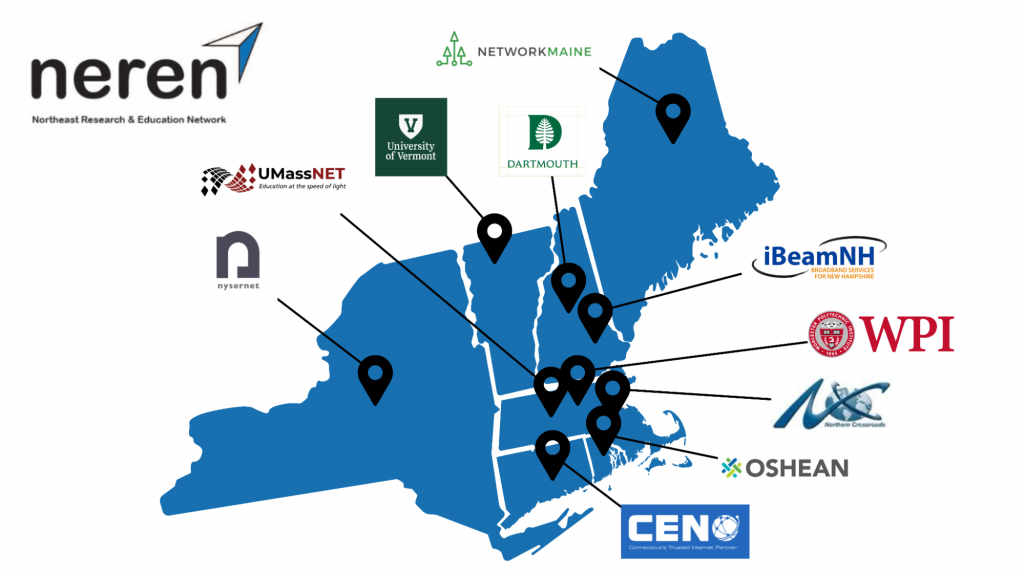
NEREN’s membership is made up of the primary research and education networks and leading institutions across the Northeast. Institutions and affiliates connect to NEREN through their state’s research and education network, and NEREN then interlinks these state networks to one another and to Internet2.
State Networks
Examples such as the Connecticut Education Network (CEN), OSHEAN in Rhode Island, Network Maine, New Hampshire’s IBeam NH, UMassNet, and New York’s NYSERNet. Each serves multiple colleges, universities, government facilities, and K–12 systems in its state.
Individual Institutions
In states without a dedicated network, such as the University of Vermont, Dartmouth College, the University of Massachusetts Amherst, and Worcester Polytechnic Institute.
Affiliate Organizations
Research and education, and government-focused entities that participate in NEREN’s collaborative community.
Mission & Values
Our mission is to provide the advanced connectivity that research and education depend on, and to enable peer-to-peer collaboration. We value:
Collaboration
We maximize progress, the efficient use of resources, and speed to deliver new services by working together. Through supporting the network, we accelerate research that ultimately benefits the public and the economy.
Trust
We are committed to transparency, security, and reliability in everything we do. We work to open communications and to hold ourselves accountable for the highest level of communications, ethical behavior, and collaboration among NEREN and its member organizations.
Service
As a member-driven organization, we exist solely to meet the unique needs of our community and to sustain our ability to support our community. Success for NEREN does not include a profit or growth objective.
Innovation
We ensure the Northeast has the cutting-edge infrastructure necessary to retain a competitive edge in discovery, bolstering the region’s — and nation’s — global standing in research and technology.
Why RENs Exist
Like the interstate system did for commerce in the last century — and railroads in the century before that — Research and Education Networks (RENs) are the digital infrastructure powering research and innovation in the 21st.
RENs are designed specifically for higher education and research, and they meet capacity, security, and operational requirements for unique research projects. RENs carefully craft their network architectures and business models to enable rapid adoption and superior bandwidth capacity before commercial providers are able to do so. When members share information across a REN, it travels directly between trusted institutions rather than through multiple third-party networks. This point-to-point design reduces vulnerabilities while increasing speed and resiliency, which is critical for data-intensive projects.
Much like the “digital divide” and its impact on society, there are similar differences between regions that invest in advanced digital infrastructure and those that do not. Regions with strong RENs tend to attract more funding and partnerships. Without networks like NEREN, institutions are limited in their ability to share knowledge, drive discovery, and contribute to the economy.
Leadership

Rob Vietzke
Executive Director
NEREN

Laurie Robinson
Program Manager
NEREN

Rick Tuthill
Chair of the Technical Committee
NEREN

Jon Domen
Senior Engineer
NEREN
Board of Directors
NEREN’s Board of Directors brings together diverse thought leaders and technical experts from research and education networks, universities, and partner organizations across the Northeast.
Chairman
Ryan Kocsondy
(State Network Director – CT)
Executive Director
Connecticut Education Network
The Office of President has not been appointed
Secretary
David Marble
(State Network Director – RI)
President and CEO
OSHEAN, Inc.
Treasurer
Christopher Misra
(State Network Director – MA)
Vice Chancellor and CIO
University of Massachusetts at Amherst
Directors
Charles von Lichtenberg (MA)
Director Network Architecture and Engineering
Boston University
Christopher Misra (MA)
Vice Chancellor and CIO
University of Massachusetts at Amherst
Darcy Pientka (VT)
Deputy Chief Information Officer
University of Vermont
David Marble (RI)
President and CEO
OSHEAN, Inc.
Felix Windt (NH)
Chief Technology Officer
Dartmouth College
Gabriele Fariello (RI)
Interim Chief Information Officer
University of Rhode Island
John P. Barden (CT)
Chief Information Officer
Yale University
Dr. Kellie B. Campbell, EdD (VT)
Chief Information Officer
University of Vermont
Michael R. Mundrane, Ph.D. (CT)
Chief Information Officer
Connecticut State Colleges and Universities
Ryan Koscondy (CT)
Executive Director
Connecticut Education Network
Committees
NEREN’s committees help guide the organization’s strategy and operations, ensuring that decisions reflect the expertise and priorities of its member networks.
Financial Committee
Oversees fiscal planning, budgeting and sustainability to maintain transparency and responsible stewardship of member resources.
Nominations Committee
Supports governance by identifying and recommending candidates for Board and committee roles, ensuring balanced regional representation.
Technical Committee
Advises on network architecture, performance, security and service development to ensure NEREN continues to meet the evolving needs of research and education.
Members